How to Boost TikTok Views: An Actionable 2026 Guide
Other
You’re probably doing more work than the average TikTok creator and getting less reach for it.
A familiar pattern looks like this. You publish strong long-form content on YouTube, record solid podcast episodes, or run webinars packed with useful material. Then you cut a clip, post it to TikTok, and it barely moves. A handful of views. Weak watch time. No comments. No second push.
That gap isn’t usually about effort. It’s about format, pacing, and signal quality.
TikTok doesn’t reward content because it was valuable in its original form. It rewards content that performs inside TikTok’s own system. A smart ten-minute YouTube segment can fail on TikTok if the first seconds are slow, the framing feels repurposed in a lazy way, or the edit doesn’t create enough rewatch and share potential. Meanwhile, a simpler clip with a sharper hook can spread fast.
I’ve seen this frustrate marketers, educators, founders, and creators who already have a real content engine. They assume the hard part was making the source material. On TikTok, that’s only half the job.
The good news is that you don’t need to throw away your existing library or start dancing for reach. You need a workflow that translates good ideas into TikTok-native execution. That means understanding how distribution works, how attention is earned in the first seconds, and how to turn long-form assets into clips that fit the feed.
The Real Reason Your TikToks Aren't Getting Views
Most weak-performing TikToks don’t fail because the topic is bad. They fail because the packaging tells the algorithm and the viewer the wrong story.
A podcast clip might open with a host clearing their throat, smiling, and saying, “So today we’re going to talk about…” On YouTube, that can be fine. On TikTok, that opening often burns the exact moment that decides whether the video gets any traction at all. The platform is crowded, fast, and brutal about early drop-off.
Another common problem is mistaken quality. Creators think “high quality” means polished lighting, a fancy camera, and branded intros. TikTok usually responds better to content that feels native to the platform. Clean audio matters. Clear visuals matter. But overproduced intros, dead space, and horizontal leftovers often hurt more than they help.
Where long-form creators usually go wrong
If you already have a content library, these are the friction points that show up most:
- The clip starts too early. You include setup instead of the strongest line.
- The frame looks wrong. Important faces, gestures, or text sit outside the vertical focal area.
- The payoff comes too late. The viewer has to wait before they understand why they should care.
- The edit ignores TikTok behavior. No captions, weak on-screen text, and no reason to replay.
The algorithm can’t reward a video that people don’t stay with long enough to understand.
The fix isn’t “post more.” Posting more bad cuts just gives you more evidence that the wrong format doesn’t work.
What actually changes results
Better TikTok performance comes from matching strong source material with platform-specific editing decisions. You need clips that open on tension, teach or entertain quickly, and keep momentum all the way through. If you’re trying to boost tiktok views, that’s the shift that matters most.
Creators who win on TikTok consistently aren’t always making better ideas. They’re presenting those ideas in a way TikTok can distribute.
Decoding the 2026 TikTok Algorithm
TikTok doesn’t push every upload to the same size audience. It tests first, then expands distribution if the response is strong enough.
According to Socialinsider’s breakdown of TikTok video promotion , TikTok uses a 5-point engagement scoring system that starts with an initial test audience of approximately 300 random users. Engagement types carry different weights: likes are worth 1 point, comments 2, shares 3, full watches 4, and rewatches or replays 5. Videos that hit 50+ points in that test phase can see 10x reach expansion.
That framework explains why some videos stall immediately while others get a second and third wave of exposure. TikTok is measuring value through behavior, not through your opinion of the clip.
What the platform is really rewarding
The weighting tells you what TikTok considers stronger proof:
SignalWeightWhat it suggests
Like
1 point
Mild approval
Comment
2 points
The video triggered a response
Share
3 points
Someone thought it was worth sending
Full watch
4 points
The structure held attention
Rewatch
5 points
The content was compelling enough to repeat
A creator focused only on likes is chasing the weakest signal in the stack. Rewatches and full watches matter more because they indicate that people didn’t just notice the clip. They stayed.
This is also why a short video with sharp pacing can outperform a better-looking one. If the edit creates curiosity, surprise, or density, people replay it. That behavior sends a stronger promotion signal.
How to build for the test phase
The first job of any TikTok is survival. If it can’t hold attention with a cold audience, it won’t earn broader distribution.
A practical workflow looks like this:
- Open with the strongest claim or moment. Don’t spend the first seconds explaining context.
- Make the value obvious fast. The viewer should understand what they’ll get almost immediately.
- Design for completion. Remove filler, pauses, and anything that slows the clip down.
- Give viewers a reason to react. A sharp opinion, useful tip, or surprising example creates comments and shares.
Practical rule: Build every TikTok as if it has to win over strangers in the first seconds, because that’s exactly what it has to do.
The algorithm isn’t mysterious when you look at it this way. It’s a distribution filter. Strong early response leads to more reach. Weak response caps the video before it gets a real chance.
Crafting Content That Captures and Holds Attention
The fastest way to lose TikTok views is to make the viewer work too hard before the payoff starts. A good TikTok gives the audience a reason to stay almost instantly, then keeps tightening the loop until the last frame.
The opening matters most, but not in a vague “have a hook” way. It needs to create immediate relevance. That usually means tension, novelty, or a useful promise.
Hook formats that keep people from scrolling
Some openings consistently work better than broad intros:
- Direct mistake callout
“Most creators kill their TikTok in the first sentence.” - Outcome-first framing
“This is the easiest way to turn one podcast into a week of TikToks.” - Open loop
“I thought this clip would flop. One edit changed everything.” - Specific audience callout
“If you post YouTube clips to TikTok, stop trimming them this way.” - Mid-action start
Open on the strongest visual or line, then add context after the viewer is already in.
What doesn’t work well is throat-clearing. “Hey guys.” “Welcome back.” “So today I wanted to talk about…” Those lines ask for patience before you’ve earned it.
Structure the middle for completion
A good hook gets the view. The middle earns the full watch.
The cleanest format is usually one idea per clip. If you try to force three lessons, two examples, and a story into one short, the pacing falls apart. TikTok rewards clarity more than coverage.
Use this basic structure:
- Start with the tension
- Deliver the insight quickly
- Show the proof or example
- End on a line that closes the loop or invites a response
If you need editing help, this roundup of TikTok editing apps for creators is a useful place to compare workflows.
A small but important detail is visual rhythm. Change frames, add text beats, cut dead air, and keep motion on screen. The viewer should feel progress.
Here’s a useful reference for pacing and visual retention cues:
Build clips people want to replay
Replays usually come from one of three patterns:
- Dense information. The viewer wants to catch a detail they missed.
- A looped ending. The last frame connects smoothly back to the start.
- A fast reveal. The answer lands quickly enough that people rewatch to study how you got there.
A TikTok that says one clear thing well will usually outperform a cluttered video that tries to say everything.
Many repurposed clips fail by preserving the original conversation instead of extracting the sharpest standalone moment. TikTok doesn’t need the whole discussion. It needs the most watchable fragment.
Essential Technical Optimizations for Maximum Reach
Technical choices on TikTok aren’t cosmetic. They’re distribution signals.
A lot of creators still treat sound, captions, and formatting as optional polish. On TikTok, those details affect whether the platform can understand the content and whether viewers stay with it long enough to trigger stronger engagement signals.
Audio and quality are not optional
According to TokPortal’s 2025 TikTok views analysis , videos with background music receive an average of 98.31% more views than videos without it. The same analysis notes that high-quality videos achieve 40x follower growth compared with low-quality ones.
That doesn’t mean every video needs loud trend audio layered over it. It means audio matters as a discovery and retention cue. Even subtle background music can make a clip feel native to the feed instead of dropped in from another platform.
High quality also doesn’t mean “corporate.” It means the clip is easy to consume on a phone. Clear face framing. Clean captions. Readable text. No awkward black bars. No tiny speaker window from a webinar recording.
The technical checklist that actually matters
Before publishing, check these elements:
- Vertical framing: Keep the subject centered for a phone screen. If the source video is horizontal, crop around the speaker or key action instead of shrinking the whole frame.
- Captions: Add on-screen subtitles because many viewers watch with low volume or no volume. A tool like this subtitle generator for short-form clips speeds up the process.
- On-screen text: Reinforce the main idea with a headline in the opening seconds.
- Audio layering: Use background music thoughtfully so the clip feels native without fighting the spoken content.
- Clean exports: Avoid blurry uploads, low-resolution screen recordings, or mismatched aspect ratios.
What hurts reach even when the idea is good
The most common technical mistakes are easy to spot:
MistakeWhy it hurts
Horizontal leftovers
The clip looks recycled and wastes screen space
No captions
Viewers miss the message in silent or low-volume viewing
Weak audio mix
Speech gets lost or the clip feels flat
Tiny on-screen text
The hook isn’t readable on mobile
Overdesigned branding
It slows the video and feels less native
When creators say they want to boost tiktok views, they often jump straight to hashtags or posting times. That’s backwards. If the clip doesn’t look and sound like it belongs in the feed, distribution problems start before the caption even matters.
Repurpose Your Videos Into Viral Shorts with AI
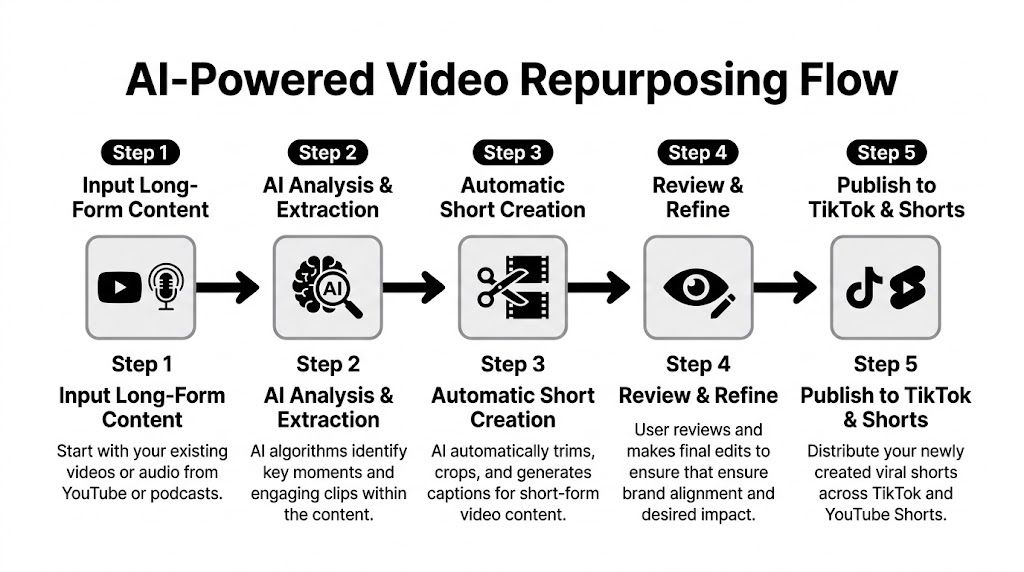
If you already have a library of YouTube videos, interviews, webinars, courses, or podcast recordings, creating every TikTok from scratch is usually the slowest possible path.
For long-form creators, repurposing is the more efficient play because the raw material already exists. The primary work is extracting the moments that can survive in short-form and reshaping them for a vertical, fast-scrolling environment.
According to Hootsuite’s coverage of short-form repurposing data , a 2025 VidIQ report found that 68% of viral TikToks under 15 seconds are excerpted from longer content, yet only 12% of creators use automation. The same source notes that repurposed clips can achieve 3x higher initial views when AI identifies stronger hooks.
That gap matters. It means a lot of creators are still doing manual clipping, guessing at hooks, and spending hours on edits that could have been generated and refined much faster.
Why manual clipping breaks at scale
Manual repurposing works when you have one episode and plenty of time. It breaks when you’re managing a content pipeline.
The problems stack up fast:
- You have too much footage to review
- Your best moments are buried in long conversations
- Vertical reframing takes time
- Captions and timing need cleanup
- Consistency drops when the workflow depends on manual effort
A social team can do this by hand. But doing it every week across multiple channels gets expensive in time and attention.
Repurposing isn’t a shortcut. It’s a way to get more output from ideas you already paid to create.
The AI workflow that makes repurposing practical
A better process looks like this:
- Start with a strong source asset
Upload a podcast, webinar, interview, or YouTube episode with clear spoken moments. - Let AI scan for candidate hooks
Instead of scrubbing through the entire timeline manually, use an AI TikTok video generator to identify moments that can stand alone. - Auto-reframe for vertical viewing
Good repurposing tools center the speaker, resize the content for phone-first viewing, and preserve the visual focal point. - Generate captions and text layers
This turns spoken content into something readable and more feed-native. - Review, trim, and sharpen
AI gets you to a strong draft fast. Human review still matters. Tighten openings, cut slow beats, and make sure each clip works without the original context.
How to choose better source moments
Not every useful moment becomes a strong TikTok.
The clips worth repurposing usually have one of these traits:
- A clear opinion
- A surprising insight
- A self-contained lesson
- A strong sentence that works as the opening line
- A visible emotional reaction or memorable delivery
If you’re pulling from interviews or podcasts, audio can become its own asset too. For teams that want to extract or reuse sound from short-form content during the ideation phase, a practical guide to Tiktok To Mp3 can help with audio-first workflows.
What AI still won’t do for you
AI speeds up clipping. It doesn’t replace judgment.
You still need to choose which clips fit your audience, which ones match your brand voice, and which openings feel strong enough for the feed. The best results come from combining automation with editorial standards. Let the tool handle the heavy lifting. Keep the final call for yourself.
That’s the main advantage. You stop spending your energy on repetitive editing tasks and spend it on choosing better angles, better hooks, and better publishing decisions.
Publishing and Engagement Tactics to Fuel Growth
A strong video can still underperform if you publish it carelessly.
TikTok gives you early feedback fast. That means the hours right after posting matter more than many creators realize. If you want to boost tiktok views, treat publishing as an active step, not the end of the process.
Use your own analytics, not generic posting advice
The right posting time depends on when your audience is active. A B2B consultant, gaming creator, and podcast host won’t have the same pattern. Check your TikTok analytics and look for the windows where your followers are online and recent videos have held attention best.
Then build a lightweight testing schedule around that pattern. If your content operation is getting messy, a practical social media calendar template helps keep experiments organized without overcomplicating the process.
Keep your hashtag strategy narrow and intentional
Don’t stuff the caption with broad tags that say almost nothing.
A better mix usually includes:
- A niche tag: Something tightly related to the topic
- A format tag: Something that reflects the type of post
- A topical keyword: A phrase people might search inside TikTok
- A broad tag only if it fits naturally: Not as filler
The caption should also do a job. Ask a real question, frame a debate, or invite the viewer to choose between options. Comments aren’t just social proof. They tell TikTok the video generated a response.
What to do after posting
Most creators post and leave. That’s wasted momentum.
Use the first stretch after publishing to:
- Reply to comments quickly: Keep the thread alive while the post is fresh.
- Pin a useful comment: Guide the conversation toward the angle you want.
- Turn good comments into follow-up videos: That extends the lifespan of the original topic.
- Watch audience language: Repeated phrases in comments can become future hooks and captions.
A post that starts conversation has a better chance of earning more distribution than one that only collects passive views.
Duets and Stitch still have value when they connect to your niche and add a real take. Forced trend participation usually creates noise. Focus on interactions that deepen your positioning, not random visibility.
Frequently Asked Questions About TikTok Views
Should I delete a TikTok that flopped
Usually, no.
A weak early result doesn’t always mean the idea was wrong. It may have been the hook, the framing, or the caption. Before deleting, review the opening, pacing, and whether the clip made sense without outside context. If the core idea is solid, rework the edit and repost a stronger version later rather than obsessing over the original upload.
Is it better to make short TikToks or longer ones
The better length is the one that keeps attention all the way through.
Some ideas work best as very short clips because they create replay value. Others need a little more room to land. The mistake is dragging a simple idea longer than it needs. The strongest edits usually feel tight, intentional, and complete.
Do old videos ever start getting views later
Yes, they can.
TikTok can resurface content when it finds a better audience match or renewed relevance around a topic. That’s one reason clean keywords in speech, captions, and on-screen text matter. A video’s first push matters, but it isn’t always the last chance it gets.
How many TikToks should I create from one long-form video
As many as the source material can support.
A good podcast or interview often contains multiple standalone moments with different hooks. One clip might be educational. Another might be opinion-driven. Another might be built around a story. Don’t force quantity, but don’t assume a single source only contains one usable short.
What’s the fastest way to improve TikTok views without making new content
Audit your existing library and cut better clips from content you’ve already published elsewhere.
That approach is faster because the ideas already exist. Your job is to identify the strongest moments, reshape them for vertical viewing, and publish them with stronger hooks and clearer packaging. For established creators, that’s often the most impactful action available.
If you already have long-form videos sitting on YouTube, in your podcast feed, or inside webinar recordings, Klap helps you turn them into social-ready shorts much faster. It identifies clip-worthy moments, reframes for vertical formats, adds captions, and cuts down the manual editing work so you can publish more high-quality TikToks from content you’ve already made.